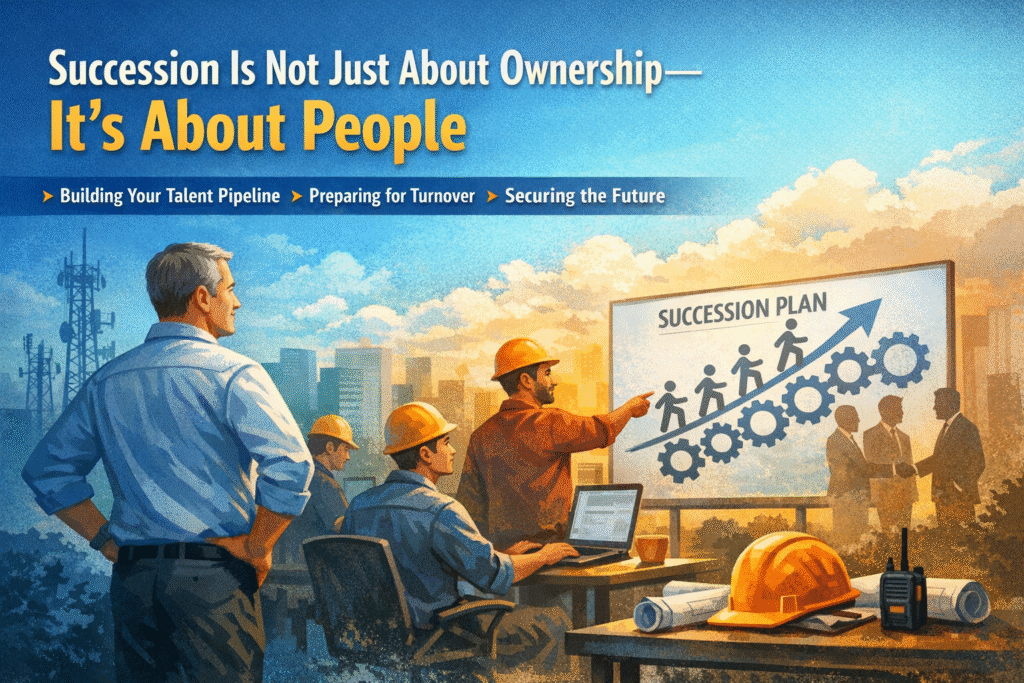
Succession Is Not Just About Ownership—It’s About People
When people hear the word succession, they often think of ownership transfer, family businesses, or preparing the “next in line” leader.
But succession is much broader than that.
Succession is really about continuity.
And continuity depends not just on who owns the business—but on who does the work, carries the knowledge, and keeps performance steady when change happens.
That’s why succession planning is just as critical for manpower and resource management as it is for leadership and ownership.
The Overlooked Succession Risk: People Leaving
Earlier in my career, I worked as a Senior Manager at a Telecommunications Company. One of our biggest challenges wasn’t technology or systems—it was people turnover.
Engineers were in high demand.
Competitors regularly tried to pirate our talent.
And retaining enough skilled people to meet operational targets became a constant struggle.
Every time an engineer left, the pressure increased:
-
Workloads piled up
-
KPIs were at risk
-
Morale was tested
-
Leaders were forced into firefighting mode
We realized something important:
If we waited until people resigned before acting, we were already too late.
The Shift: Building a Succession Pool Before the Crisis
Instead of reacting to turnover, we made a strategic decision.
We created the OTP Program (Operations Training Program).
Every year:
-
We pre-hired 10 to 15 engineers
-
We trained them intentionally
-
We immersed them in our systems, culture, and standards
-
We treated them as a future-ready talent pool, not just new hires
These engineers became our succession bench.
So when someone left:
-
We didn’t panic
-
We didn’t scramble
-
We didn’t miss our KPIs
We had prepared people ready to step in.
That strategy worked.
It protected performance.
It reduced leadership stress.
It allowed my team to focus on execution rather than crisis management.
What That Experience Taught Me About Succession
That experience reshaped how I see succession planning today.
Succession is not:
-
A last-minute replacement plan
-
A document kept in HR files
-
A conversation reserved for retirement
Succession is:
-
A leadership responsibility
-
A people-development system
-
A risk-management strategy
Whether you are running a family business, an SME, or a growing organization, the principle is the same:
If your business depends on irreplaceable people, your business is fragile.
Succession in Manpower Management
In today’s environment—where talent mobility is high and competition is aggressive—leaders must ask:
-
Who is ready if a key person leaves tomorrow?
-
Are we developing people faster than we are losing them?
-
Do we have a leadership and talent bench, or just job titles?
Succession planning for manpower means:
-
Hiring ahead of growth
-
Training before vacancies happen
-
Developing people beyond their current role
-
Creating a culture where learning and leadership reproduction are intentional
From Telecom to Legacy Building™
That lesson stayed with me.
Today, in my Legacy Building™ / Succession Program, I teach the same principle to business owners and leaders:
Succession is not about replacing people—it’s about reproducing capability.
When leaders build:
-
Leadership depth
-
Talent pipelines
-
Values-based development
They don’t just protect the business.
They secure the future.
Final Reflection for Leaders
Succession planning is not only for founders nearing exit.
It is for any leader who wants stability, scalability, and peace of mind.
Because the real question is not:
“What happens when someone leaves?”
The better question is:
“Are we prepared when it happens?”
That is the heart of succession, and the foundation of a lasting legacy.