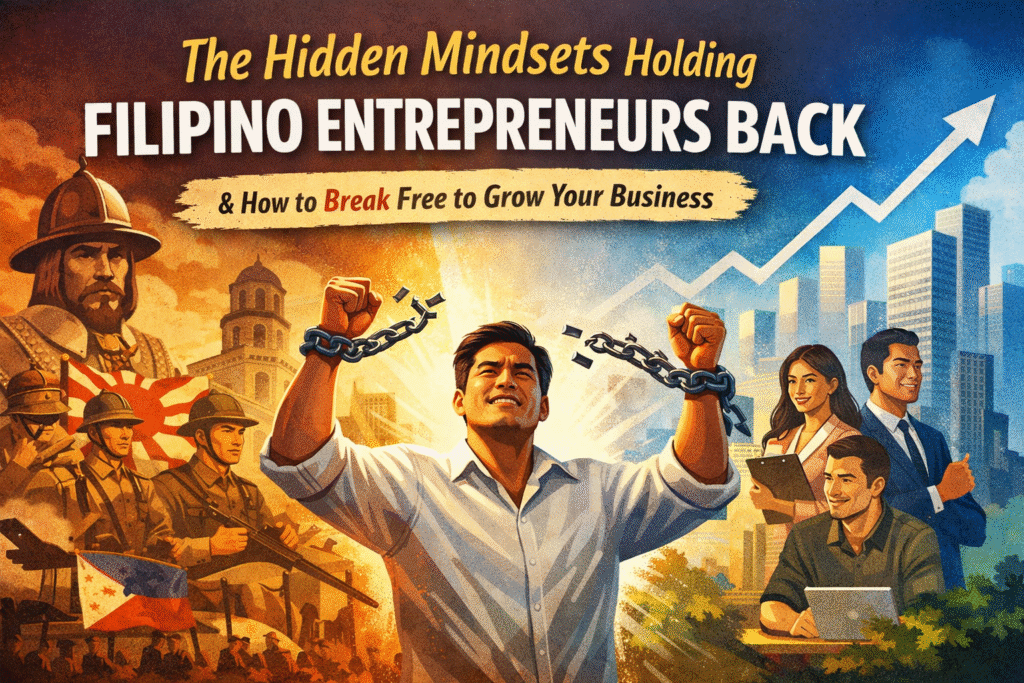
The Hidden Mindsets Holding Filipino Entrepreneurs Back
And Why Mindset Is the First Chapter of the Trinity of Growth™
When I started my journey as a business coach and consultant, I noticed something that both puzzled and challenged me.
No matter how effective the coaching tools were…
No matter how solid the strategies and frameworks were…
No matter how committed the business owner was…
Progress would eventually stall.
Over time, I realized the common denominator wasn’t skill, systems, or even effort.
It was mindset.
But what exactly is mindset?
Mindset is the set of beliefs, assumptions, and internal narratives that shape how we interpret challenges, make decisions, respond to failure, and define success. It determines whether we see obstacles as threats—or as opportunities to grow.
And mindset doesn’t form in a vacuum.
It is shaped by:
-
Family
-
Education
-
Culture
-
History
Which led me to ask a deeper question—one I could no longer ignore as a Filipino coach working with Filipino entrepreneurs:
Where did our mindset come from?
Looking Back: How History Shaped the Filipino Mindset
The Philippines was shaped by centuries of colonization.
-
Spanish rule lasted for more than 333 years (1565–1898)
-
American rule spanned roughly 48 years (1898–1946)
-
Japanese occupation lasted about 3 years (1942–1945)
These were not just political occupations.
They shaped how Filipinos learned to think about:
-
Authority
-
Risk
-
Leadership
-
Work
-
Survival
-
Success
Many of the challenges Filipino entrepreneurs face today are not new problems.
They are old mindsets operating in modern businesses.
The Problem: We Work Hard—Yet Many Businesses Stay Small
Filipino entrepreneurs are some of the most hardworking people I know.
We hustle.
We sacrifice.
We endure.
And yet, many small businesses struggle to scale, professionalize, or grow beyond the owner.
This is not because we lack intelligence.
It is not because we lack discipline.
It is because effort alone cannot overcome inherited ways of thinking.
The Villain: Inherited Mindsets We Never Chose
Our colonizers didn’t just influence our systems and institutions.
They shaped how we respond to pressure.
Let’s name the most common inherited mindsets—and how they show up in business today.
1. The Spanish Colonial Mindset
“Stay Safe. Don’t Stand Out.”
Centuries of Spanish rule instilled deep respect for authority, hierarchy, and harmony.
While these values fostered community and faith, they also created unintended consequences.
How this shows up in business today
-
Leaders avoid difficult conversations to preserve harmony
-
Family businesses tolerate underperformance
-
Decisions are delayed to avoid conflict
-
Vision remains vague so no one is offended
The hidden cost
You cannot scale a business you are afraid to clearly lead.
Mindset shift
From: “Don’t rock the boat.”
To: “Clarity is kindness.”
Leadership requires courage—not just good intentions.
2. The Japanese Occupation Mindset
“Endure Quietly. Survive at All Costs.”
The Japanese occupation forged resilience into the Filipino identity.
It taught discipline, sacrifice, and the ability to endure extreme hardship.
These strengths helped our people survive.
But survival thinking becomes dangerous when it becomes permanent.
How this shows up in business today
-
Burnout is normalized
-
Overwork is praised
-
Leaders stay in constant crisis mode
-
Rest feels like weakness
The hidden cost
You cannot build a future while living in survival mode.
Mindset shift
From: “Just endure.”
To: “Design a business that sustains you.”
Growth is not about surviving longer—it’s about building better.
3. The American Colonial Mindset
“Follow the System. Wait for Direction.”
American influence brought education, structure, and corporate systems—many of which we still benefit from today.
But it also reinforced employee thinking. (Note: Nothing bad about being an employee. It’s only the mindset that limits creativity.)
How this shows up in business today
-
Entrepreneurs wait for validation before deciding
-
Leaders copy models instead of creating direction
-
Success is defined by titles, not impact
-
Ownership is replaced by compliance
The hidden cost
You cannot lead like an entrepreneur if you are thinking like an employee.
Mindset shift
From: “Tell me the rules.”
To: “I create the direction.”
Entrepreneurship demands ownership—not permission.
Fixed Mindset or Growth Mindset—Where Do Filipinos Stand?
This leads to another important question:
Do Filipinos have a fixed mindset or a growth mindset?
According to Carol Dweck, author of Mindset, a fixed mindset believes that intelligence, talent, and ability are static, while a growth mindset believes they can be developed through learning, effort, and feedback.
Filipinos often live in a blend of both:
-
We believe in hard work (growth)
-
But we fear failure and judgment (fixed)
-
We endure hardship (growth)
-
But avoid risk and visibility (fixed)
The issue is not capability.
It is belief.
What Filipino Entrepreneurs Must Work On to Grow Their Mindset
To move forward, Filipino entrepreneurs must intentionally work on:
-
Reframing failure as feedback, not shame
-
Replacing endurance with design, not burnout
-
Choosing ownership over compliance
-
Valuing clarity over comfort
-
Believing growth is learned, not inherited
Mindset growth does not erase our history.
It redeems it.
Why This Became Chapter One of The Trinity of Growth™
As I was writing this book, The Trinity of Growth™, one realization became clear:
Before leadership skills…
Before business systems…
Before networks and connections…
Mindset must shift first.
Because how you think determines:
-
How you lead
-
How you build
-
How you grow with others
That is why this topic became the first chapter.
You cannot outgrow a mindset you never outgrow internally.
Final Thought
History shaped us—but it does not have to limit us.
The greatest work Filipino entrepreneurs must do today is not working harder.
It is thinking better.
And when mindset changes, everything else finally has room to grow.
Soft Call to Action
If you’re a business owner who feels stuck—not because of effort, but because something deeper needs to shift—this journey begins with mindset.
And mindset grows best when guided, supported, and practiced daily.