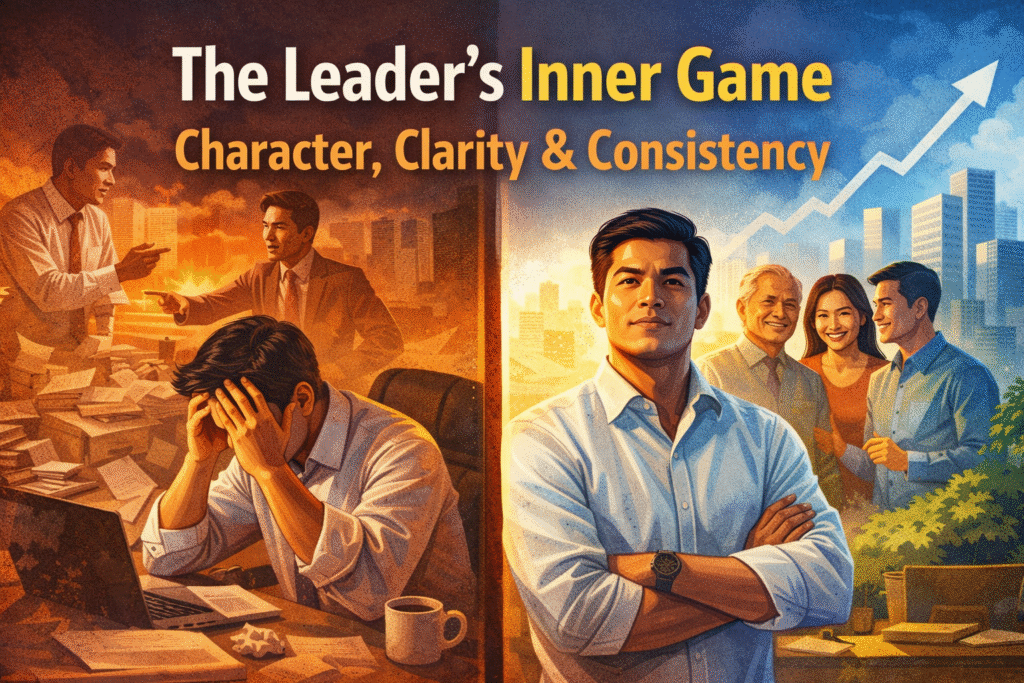
The Leader’s Inner Game
Character. Clarity. Consistency.
“The hardest person you will ever lead is yourself.” — John C. Maxwell
The Hidden Side of Leadership
When people think of leadership, they imagine authority — making decisions, giving direction, being in control.
But true leadership begins long before you lead others.
It begins inside — in the quiet, unseen places of your heart and mind.
This blog is an overview of Chapter 2 of my upcoming book, The Trinity of Growth™. Much of what shaped this chapter is inspired by the leadership principles of John C. Maxwell — particularly from his book Developing the Leader Within You 2.0, where he emphasizes a foundational truth: leadership rises or falls on character.
Before influence becomes visible, integrity must become internal.
The Foundation: Character
A Quiet Test of Integrity
Early in my transition from corporate life to entrepreneurship, I was negotiating a sizable engagement with a company that could have significantly stabilized my income.
The client liked the proposal.
The numbers were almost finalized.
Then a subtle suggestion was made.
“If we adjust the scope slightly on paper,” they said, “we can release payment faster.”
It wasn’t illegal.
It wasn’t outrageous.
It was simply… convenient.
And I remember sitting there thinking:
“No one would really know.”
But leadership is rarely tested in public.
It is tested in private, in moments where compromise looks practical.
I realized something that day.
If I needed to bend my values to grow my business, I wasn’t building growth—I was building a dependency on shortcuts.
So I declined the adjustment.
The deal fell through.
It hurt financially.
But something more important solidified internally.
My leadership would not be for sale.
In business, you can recover revenue.
Recovering credibility is far more expensive.
That experience reinforced what I now teach:
Character is not proven when it is convenient.
It is proven when it costs you something.
Good character does not guarantee that you will be successful.
But poor character will eventually derail you — personally and professionally.
That is not a theory.
It is leadership history.
The encouraging truth is this:
Character can be changed.
No matter what your past looks like, you can choose a better path forward.
Maxwell reminds us that talent is a gift, but character is a choice.
And leadership rests on that choice.
Why Character Matters
Character matters because character builds trust.
And trust is the foundation of leadership.
When trust is low:
- communication slows down
- collaboration weakens
- decisions become cautious
- productivity drops
- costs rise
People often leave leaders, not companies.
Trust is not a soft issue. It is a leadership issue.
Trust Is a Leadership Responsibility
Leaders cannot demand trust.
They must earn it.
And more importantly, they must go first.
Trust grows when leaders:
- act consistently with their values
- keep their word
- take responsibility
- extend trust to others
You don’t build trust by insisting people believe in you.
You build trust by proving you are trustworthy.
Trust Is Built Over Time
Every interaction with your team is either a deposit or a withdrawal in what Maxwell calls a “trust account.”
When your actions align with your words, you make deposits.
When they don’t, you make withdrawals.
Over time, people believe what you do more than what you say.
And when character has built strong trust, even mistakes can be absorbed without destroying relationships.
Because credibility has already been established.
Bottom Line
Character creates credibility.
Credibility builds trust.
Trust sustains influence.
And influence is leadership.
As Filipino entrepreneurs, we often pride ourselves on diskarte — the ability to make things work no matter what.
But diskarte without discipline can lead to shortcuts.
Integrity is the invisible capital of every business.
You can outsource skills.
You cannot outsource trust.
And in business, trust is what people ultimately pay for.
The Compass: Clarity
Busy, But Drifting
There was a season in my business when my calendar was full.
Trainings.
Consultations.
Networking meetings.
Proposals.
From the outside, it looked like momentum.
But internally, I felt unsettled.
I was responding to opportunities instead of creating direction.
Saying yes because I didn’t want to miss out.
Working hard — but not necessarily moving forward.
One evening, after another long day, I asked myself a simple question:
“Is this activity aligned with the future I want to build?”
The honest answer was unclear.
And that was the problem.
Busyness can hide a lack of clarity.
Motion can disguise misalignment.
So I stepped back.
I rewrote my leadership vision.
I clarified who I serve best.
I defined what kind of impact I wanted to make.
Not every opportunity deserved a yes.
Clarity gave me permission to say no.
And once clarity was restored, energy followed.
Focus followed.
Confidence followed.
Leadership becomes lighter when direction becomes clear.
If character is the foundation, clarity is the compass.
Most business owners I coach don’t struggle because of laziness.
They struggle because of confusion.
They’re busy — but not clear.
They’re driven — but not directed.
Clarity answers three questions every leader must settle:
- Who am I? — Identity: What kind of leader do I want to be?
- Where am I going? — Vision: What future am I creating?
- Why am I doing this? — Purpose: What impact do I want to leave?
When identity is unclear, leadership becomes reactive.
When purpose is unclear, decisions become emotional.
When vision is unclear, teams become confused.
Clarity simplifies leadership.
It anchors you when everything feels urgent.
The Habit: Consistency
The Day I Chose Calm
I once had a team member publicly question a decision I made.
It wasn’t done respectfully.
It wasn’t done privately.
It caught me off guard.
For a split second, I felt the urge to defend myself — to assert authority, to correct the tone, to reestablish control.
But leadership is not measured by how you act when people agree with you.
It is measured by how you respond when they don’t.
So I paused.
I listened.
I asked clarifying questions.
And instead of reacting emotionally, I explained the reasoning behind the decision calmly and clearly.
After the meeting, that same team member approached me.
“I expected you to react differently,” he said.
That moment did more for trust than any motivational speech I could have delivered.
Consistency is not about being perfect.
It is about being predictable in your values.
When your reactions align with your principles — especially under pressure — credibility compounds.
And credibility is quiet power.
If character is the foundation and clarity is the compass, consistency is the bridge between intention and impact.
Leadership is not built in moments of brilliance. It’s built in the small, repeated actions that no one claps for.
Maxwell says:
“People do what people see.”
Your team watches how you:
- respond under pressure
- treat difficult people
- handle mistakes
- follow through on commitments
Consistency means:
- showing up when it’s inconvenient
- modeling what you expect
- living your values daily
The best compliment a leader can receive is not, “You’re inspiring.”
It’s, “You’re consistent.”
Because consistency compounds credibility.
The Inner Game Triangle
Character.
Clarity.
Consistency.
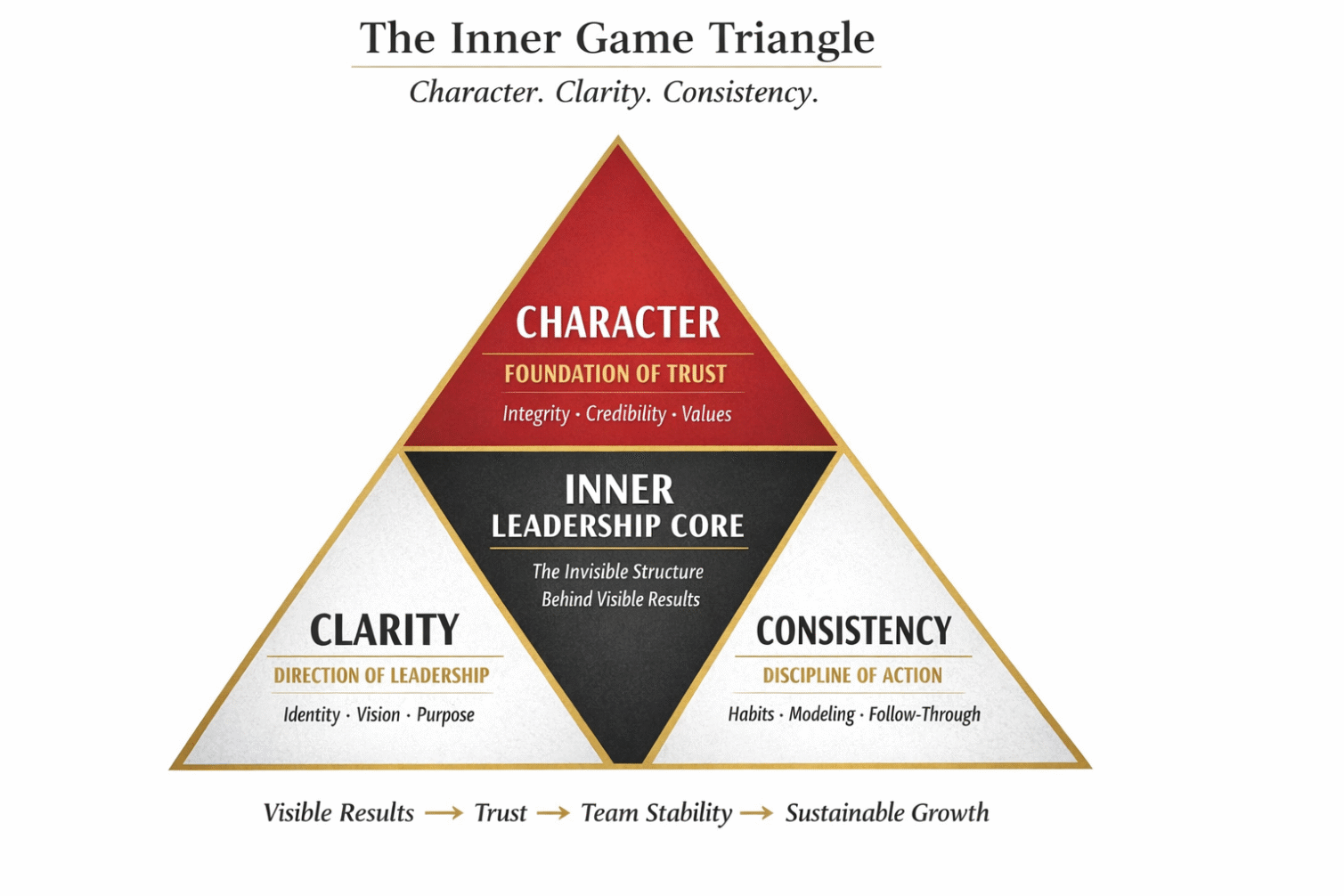
These three forces strengthen each other.
Character keeps you grounded when success tempts you.
Clarity keeps you focused when challenges distract you.
Consistency keeps you credible when people depend on you.
When aligned, they form your Inner Leadership Core — the invisible structure that sustains visible results.
Without it, leadership becomes fragile.
With it, leadership becomes durable.
Coaching Corner: Reflection & Action
Reflect:
- Where have I compromised character for convenience?
- Is my leadership vision written and clear?
- What leadership habits do I need to practice more consistently?
Act:
- Write down your top three core values and one behavior that expresses each.
- Create a short leadership declaration you can revisit daily. Example: “I lead with integrity, clarity, and consistency. I grow myself so I can grow others.”
- Ask a trusted peer or mentor: “How consistent am I in living my values?” — then listen without defending.
That is how leaders grow internally.
Years from now, people may forget your strategies.
They won’t forget your steadiness.
They won’t forget whether your words matched your actions.
They won’t forget how you responded under pressure.
They won’t forget whether you were clear or confusing.
Because leadership leaves an imprint.
And that imprint is formed in private, long before it is seen in public.
The inner game isn’t glamorous.
No one applauds unseen discipline.
No one celebrates quiet integrity.
But that is where legacy is built.
When your character is strong, your clarity is firm, and your consistency is steady —
You don’t just build results.
You build trust.
And trust is what outlives you.
Character.
Clarity.
Consistency.
Lead yourself well — and others will follow.
Closing Thought
The inner game of leadership isn’t glamorous. No one will post about it or applaud it.
But it’s what separates those who burn out from those who build legacies.
When your inner world is aligned, your outer world follows.
“Leadership isn’t about controlling others — it’s about mastering yourself.”
And mastery starts with three words that shape every great leader’s life: Character. Clarity. Consistency.