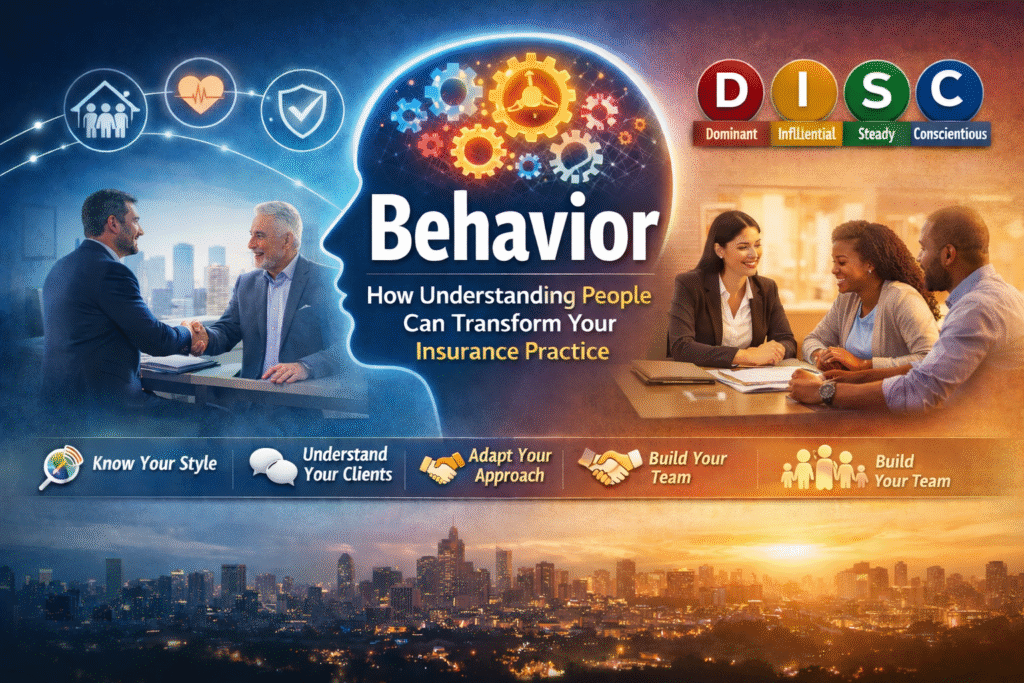
Insurance Is a People Business—Here’s How Top Advisors Win
Inspired by Brian Icenhower’s Behavior: Improve Communication and Sales Performance
Most Insurance Professionals Don’t Lose Clients Because of Price — They Lose Them Because of Miscommunication
Let’s be honest.
In insurance, you can have strong carriers, competitive products, and well-designed policy illustrations—yet still struggle to close, retain clients, or receive referrals.
Not because premiums are too high.
Not because coverage isn’t good enough.
But because clients don’t always feel understood.
That’s the insight Brian Icenhower highlights in Behavior—and it applies perfectly to insurance:
Sales is never about the product first. It’s about people.
Insurance professionals who understand human behavior, adapt how they communicate, and build trust through connection don’t just sell more policies.
They build long-term relationships.
Insurance Is a People Business—Not a Policy Business
I didn’t come to this realization by reading a book alone.
I came to it through experience.
For more than 20 years, I’ve worked with an Insurance Advisor named Tess.
Through career transitions, business growth, and different seasons of life, she stayed connected—consistently supportive, helpful, and trustworthy.
One moment stands out.
I once told her I was considering paying my premium online.
Not because I wanted to leave—but because she regularly visited me, and I didn’t want to take too much of her time.
Her response surprised me.
She said,
“It doesn’t matter to me if you pay online. If you do that, I’ll lose the chance to catch up with you.”
In that moment, I realized something important.
She wasn’t protecting a transaction.
She was protecting a relationship.
Over time, that relationship naturally grew.
My friends became her friends.
Many of my staff eventually became her clients.
Not because she pushed products.
But because she genuinely cared.
That experience is why I believe this deeply:
Insurance is not a policy business. It’s a people business.
Why Clients Say “Let Me Think About It”
Have you ever experienced this?
A prospect listens attentively, nods along—then says, “Let me think about it.”
A client buys once but never refers.
A long-term policyholder quietly moves to another provider.
Often, it’s not about the product.
It’s about a behavioral mismatch.
Every client has a natural way of:
-
Making decisions
-
Processing risk
-
Responding to information
-
Building trust
When we communicate against that style—even with good intentions—clients don’t feel safe enough to move forward.
This is where behavioral awareness changes everything.
The DISC Model: A Simple Way to Understand People
Icenhower uses the DISC Behavioral Model to explain how people communicate and decide differently:
D – Dominant
Direct, decisive, results-focused
→ Wants clarity, speed, and outcomes
I – Influential
Outgoing, relational, optimistic
→ Wants stories, connection, and encouragement
S – Steady
Patient, loyal, security-oriented
→ Wants reassurance, consistency, and care
C – Conscientious
Analytical, cautious, detail-driven
→ Wants data, comparisons, and risk clarity
DISC doesn’t label people.
It helps us respect differences.
Behavior in Action: What This Looks Like in Insurance
Think back to the advisor who stayed with me for 20 years.
She didn’t overwhelm me with features.
She didn’t rush decisions.
She adjusted her pace, her tone, and her presence.
That’s behavioral intelligence.
In practice, it looks like this:
-
With a high D client, be concise and outcome-focused
-
With a high I client, build rapport and paint the future
-
With a high S client, slow down and reassure
-
With a high C client, explain details and manage risk clearly
You’re not changing who you are.
You’re choosing to serve people the way they decide.
Your Behavior Shapes Your Insurance Practice
Icenhower makes this clear:
Top performers are not just skilled—they’re self-aware.
Your natural behavioral style affects:
-
How you prospect
-
How you explain policies
-
How you handle objections
-
How you build trust over time
When your business model aligns with your behavioral strengths:
-
You communicate more naturally
-
You experience less burnout
-
Clients feel more comfortable with you
That’s why some advisors grow quietly but consistently—year after year.
Leadership Through Behavior (For Agency Leaders)
If you lead a team, behavior becomes your most powerful leadership tool.
Understanding DISC allows you to:
-
Coach advisors based on motivation—not pressure
-
Reduce internal conflict
-
Assign roles based on strengths
-
Build teams that complement each other
When you grow people, production follows.
That’s leadership in a people business.
From Awareness to Action
Insurance exists to protect what matters most—life, family, health, and future.
If clients don’t feel understood, they won’t fully trust your guidance.
But when they do, loyalty grows naturally.
Start here:
-
Know your own DISC style
-
Observe how your clients communicate and decide
-
Adapt your language, pace, and approach
-
Build relationships before transactions
Small behavioral shifts create massive long-term results.
A Final Thought
I wrote this blog to honor an Insurance Advisor (Tess) who chose relationship over convenience, presence over pressure, and people over policies.
Her success didn’t come from selling harder.
It came from relating better.
Because in insurance, people don’t buy policies first.
They buy confidence.
They buy trust.
They buy you.
Reflection Question
In your next three client conversations, ask yourself:
-
Who wanted speed and certainty?
-
Who needed reassurance and patience?
-
Who wanted details and clarity?
Then reflect:
“How can I adjust my approach to serve them better?”
Quote to Remember
“Top advisors don’t sell products—they understand people.” — Brian Icenhower
Take the Next Step
If you’re an insurance professional or agency leader who wants to:
-
Strengthen client relationships
-
Improve conversion and retention
-
Build a behavior-smart practice
I’d love to help.
 Book a DISC Workshop for your team Or take the Maxwell DISC Assessment
 Message me or explore The DISC Self-Awareness Advantage™
Because when you understand people,
you don’t just grow your practice—you grow your influence.