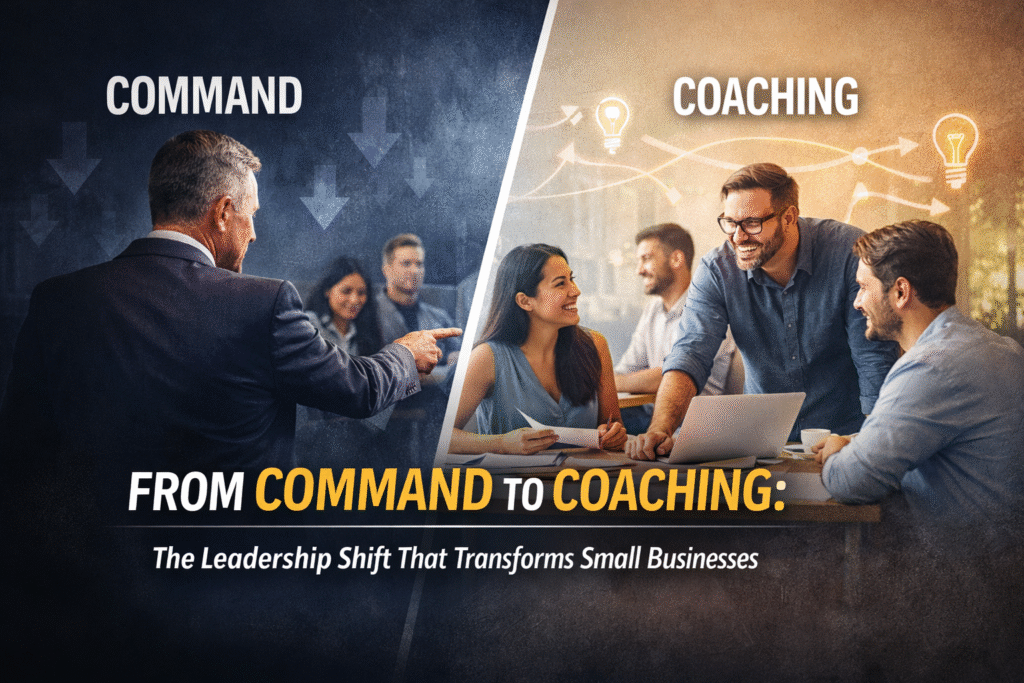
From Command and Control to Coaching: Why Small Businesses Need a Coaching Culture
For most of my career, I believed strong leadership meant being decisive, fast, and directive.
Earlier in my career, I spent more than 30 years in a telecom company where I served as one of the Heads of Operations, leading teams in a fast-paced environment where efficiency, deadlines, and results were essential.
So I led the way, many operations leaders do.
Command and control.
I instructed.
I told people what to do.
I demanded results.
At the time, I believed it was the most efficient way to lead a highly technical organization. If something needed to be done, I simply gave the order and expected the team to execute.
And to be fair, it worked—at least for a while.
But over time, I began to notice something important.
The more I controlled decisions, the more the team depended on me.
They waited for instructions.
They hesitated to make decisions.
And when problems appeared, everything seemed to flow back to my desk.
That was when I realized something that changed my leadership.
The human side of leadership matters more than the technical side.
People don’t grow when they are constantly instructed.
They grow when they are trusted to think.
So I made a deliberate shift in how I led.
Instead of always telling, I began asking more questions.
Instead of pushing harder, I began listening more carefully.
Instead of solving every problem myself, I gave my team the opportunity to learn, think, and contribute solutions.
At first, it felt slower.
But over time, something remarkable happened.
My team became more confident.
They took more ownership.
They became better decision-makers.
And the organization became stronger.
Years later, when I transitioned into entrepreneurship and began coaching business owners, that lesson became even more valuable.
Because business is not just about strategy, systems, or products.
Business is about people.
And when leaders learn how to develop people instead of simply directing them, the entire organization grows.
If your company is still leaning heavily toward command-and-control leadership, this short article is for you.
The Hidden Problem in Many Small Businesses
Many small businesses unintentionally operate the same way I used to lead.
The owner becomes the center of every decision.
Employees constantly ask:
“Boss, what should we do?”
“Is this okay?”
“Can we proceed?”
At first, this may feel efficient. But over time, it creates a serious problem.
The leader becomes the bottleneck of the organization.
The business cannot grow faster than the leader’s ability to make decisions.
That’s where coaching leadership changes everything.
Instead of giving answers, leaders begin developing thinkers.
Instead of solving problems, they begin building problem-solvers.
And that shift creates what we call a coaching culture.
What Is a Coaching Culture?
A coaching culture is an environment where leaders focus on developing people rather than just directing them.
In organizations with a coaching culture:
-
Leaders ask more questions than they give instructions
-
Employees are encouraged to think and propose solutions
-
Feedback is frequent and constructive
-
Learning becomes part of daily work
-
Growth becomes everyone’s responsibility
The goal is not simply better performance today.
The goal is to build stronger leaders for tomorrow.
How Microsoft Transformed Its Culture
One of the most well-known examples of coaching leadership can be seen at Microsoft.
When Satya Nadella became CEO in 2014, the company faced internal cultural challenges. Teams were competitive internally, collaboration was limited, and many leaders focused on proving they were the smartest people in the room.
Nadella introduced a cultural shift that became famous inside the company.
He encouraged leaders to move from a “know-it-all” culture to a “learn-it-all” culture.
Instead of focusing on being right, leaders were encouraged to:
-
Listen more
-
Learn continuously
-
Ask better questions
-
Coach their teams
Managers were trained to develop people, not just manage performance.
Over time, the cultural transformation helped reignite innovation and collaboration across the company.
Today, Microsoft is once again one of the most valuable and influential companies in the world. While technology strategy played a role, Nadella consistently credits culture and leadership transformation as a key factor in the company’s revival.
Why Coaching Culture Matters for Small Businesses
You might think coaching cultures are only for large corporations.
But in reality, they are often even more important for small businesses.
1. It develops leaders inside your company
Small businesses cannot always hire experienced leaders.
But they can develop them.
Coaching conversations help employees grow in confidence, decision-making, and accountability.
2. It removes the leadership bottleneck
When leaders coach instead of control, employees begin solving problems independently.
The business no longer depends on one person to make every decision.
That creates one of the greatest gifts for entrepreneurs:
freedom and scalability.
3. It improves communication and trust
Coaching conversations encourage listening and understanding.
When people feel heard, they become more engaged and collaborative.
Trust grows.
4. It creates continuous improvement
Organizations without coaching only improve during training sessions.
Organizations with coaching improve every day.
Because every conversation becomes a learning opportunity.
How Small Businesses Can Start Building a Coaching Culture
Building a coaching culture does not require complicated systems.
It begins with simple leadership habits.
1. Replace instructions with questions
Instead of saying:
“Here’s what you need to do.”
Try asking:
“What do you think is the best solution?”
This single change begins developing critical thinking.
2. Slow down leadership conversations
Many leaders rush conversations because they want quick results.
But sometimes slowing down allows employees to think, reflect, and learn.
That investment creates stronger leaders over time.
3. Give people room to grow
Not every decision will be perfect.
But when leaders allow employees to make decisions and learn from mistakes, confidence grows.
Growth always requires space to learn.
4. Provide coaching and leadership development
Most managers were never trained to coach.
Investing in leadership training and coaching programs helps leaders develop skills such as:
-
active listening
-
asking powerful questions
-
guiding conversations
-
developing people
These skills become the foundation of a coaching culture.
A Final Thought for Leaders
Looking back on my leadership journey, I wish I had discovered this lesson earlier.
Leadership is not about having all the answers.
It’s about developing people who can find answers together.
When leaders shift from command-and-control to coaching, something powerful happens.
The organization becomes smarter.
Teams become more confident.
Leaders begin to multiply.
And growth no longer depends on one person.
It begins to flow through the entire organization.