Leading Beyond Systems: Understanding the 4 Dimensions of Culture
The Culture You Create Is the Future You Experience
When I became a business community builder, I came to realize that every community and every company has its own culture. They have different ways of doing things. Some cultures are good, some are not so good, and many are actually damaging the organization without people realizing it.
As an Executive Director of BNI handling different Chapters, the challenge became even greater because every Chapter had a different culture, even though they followed the same system. Some Chapters were energetic, collaborative, and growth-oriented. Others struggled with trust, accountability, and consistency. The same systems existed, but the results were very different.
That made me realize something important:
Systems alone do not build organizations. Culture does.
I recently read Greg Cagle’s book The 4 Dimensions of Culture: And the Leaders Who Shape It, and it gave me language to explain what I had been seeing for years. It helped me understand why some organizations grow while others slowly decline, even with good people and good systems.
More importantly, it reminded me that culture can change when leaders understand how culture works.
I hope this blog helps leaders, team builders, and community builders find answers to some of the struggles they are experiencing inside their organizations.
The Problem Many Leaders Cannot See
Many business owners think their biggest problem is sales, marketing, operations, or manpower.
But often, the deeper issue is culture.
Culture is the invisible environment people experience every day. It affects:
-
How people communicate
-
How they solve problems
-
How they handle conflict
-
How they respond to pressure
-
How accountable they become
-
How they treat customers
-
How teams work together
Culture determines whether people merely comply or genuinely commit.
The difficult part is this:
Leaders often cannot see their own culture because they live in it every day.
But people can feel it.
When I visit organizations, I often sense the culture within minutes. You can feel whether people are energized or exhausted. Whether they are united or disconnected. Whether leaders inspire trust or fear.
Culture speaks before leaders do.
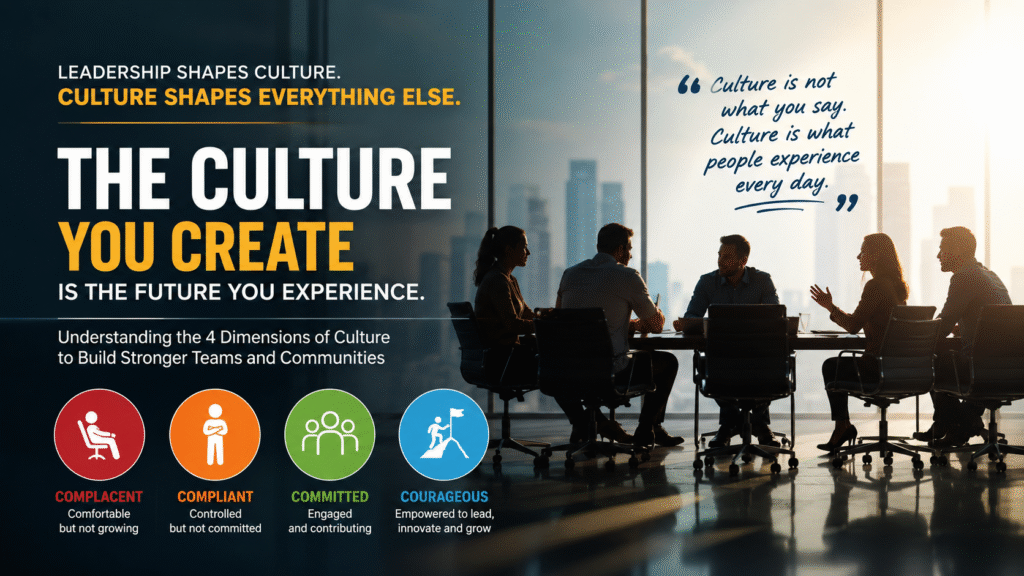
And according to Greg Cagle, every culture for every team or organization has the potential to exist in four distinct dimensions.
One of those dimensions is always negative — the Complacent Dimension — and it should be intentionally avoided because it slowly weakens growth, accountability, and momentum.
The other three dimensions are positive and necessary, but they are most powerful when mixed correctly. In fact, overemphasizing one positive dimension while neglecting the others can become destructive and eventually lead an organization back into complacency.
A healthy culture is not built through extremes.
It is built through balance.
1. The Complacent Culture
This is the culture where people settle.
The organization may still be functioning, but growth slows down because people become comfortable with mediocrity.
In complacent cultures:
-
Accountability becomes weak
-
Innovation disappears
-
Meetings become repetitive
-
Difficult conversations are avoided
-
Standards slowly decline
Nobody intentionally creates complacency. It usually develops when leaders tolerate poor habits for too long.
I have seen this happen in business groups and organizations where members stop improving because “okay” became acceptable.
The danger of complacency is subtle.
Organizations do not collapse overnight.
They slowly drift.
And drift is dangerous because many leaders mistake movement for progress.
2. The Compliant Culture
This culture looks organized on the outside but unhealthy underneath.
People follow instructions, but mostly out of fear, pressure, or obligation.
The leader controls everything.
Employees become dependent instead of empowered.
In compliant cultures:
-
People avoid mistakes rather than pursue excellence
-
Creativity decreases
-
Team members stop taking initiative
-
Communication becomes guarded
-
Trust becomes low
This is common in many small businesses where founders unintentionally become bottlenecks.
Everything needs the owner’s approval.
Every decision passes through one person.
The organization cannot move unless the leader moves.
The business may survive for a season, but eventually people become disengaged because they do not feel a sense of ownership.
However, Greg Cagle also reminds us that compliance itself is not entirely negative. Organizations still need structure, standards, and accountability. But when compliance is overemphasized without commitment, trust, and courage, people become robotic rather than responsible.
Too much control eventually weakens initiative.
3. The Committed Culture
This is where healthy organizations begin to grow.
In committed cultures:
-
People believe in the mission
-
Teams collaborate well
-
Accountability becomes natural
-
People willingly contribute
-
Leaders develop people
The atmosphere changes because people no longer ask:
“What do I need to do?”
Instead, they ask:
“How can I help?”
This is the culture many organizations desire but struggle to create.
Why?
Because commitment cannot be demanded.
It must be developed.
Leaders build commitment when they:
-
communicate vision clearly
-
model integrity consistently
-
develop relationships intentionally
-
create clarity and accountability
People commit to leaders they trust.
One thing I learned in BNI leadership is this:
Strong communities are not built by systems alone. They are built on relationships, trust, and shared purpose.
Systems support culture.
But people create culture.
Still, even commitment can become unhealthy if not balanced correctly. An organization can become highly relational and caring but avoid accountability and difficult decisions. When that happens, performance eventually declines and complacency quietly returns.
Healthy cultures need both care and accountability.
4. The Courageous Culture
This is the highest dimension of culture.
Courageous cultures are marked by:
-
High trust
-
High accountability
-
Innovation
-
Healthy conflict
-
Growth mindset
-
Ownership
-
Adaptability
In courageous cultures, people feel safe enough to speak honestly and responsible enough to improve continuously.
Mistakes become learning opportunities rather than reasons for blame.
Leaders in courageous cultures do not control people through fear.
They develop people through trust and clarity.
This is the kind of culture that allows organizations to scale sustainably.
And honestly, this is what many Filipino SMEs need today.
Not just better strategies.
Not just better systems.
But healthier cultures.
At the same time, courage without balance can also become destructive. An organization that constantly pushes innovation, disruption, and change without structure or commitment can eventually create confusion, burnout, and instability.
A healthy culture requires a balance between:
-
accountability and trust
-
systems and relationships
-
courage and consistency
Leadership Always Shapes Culture
One of the biggest lessons I learned from Greg Cagle’s book is this:
Leaders shape culture whether intentionally or unintentionally.
Culture is formed by:
-
what leaders reward
-
what leaders tolerate
-
what leaders repeat
-
what leaders model daily
If leaders gossip, teams gossip.
If leaders avoid accountability, teams avoid accountability.
If leaders pursue growth, teams pursue growth.
Culture reproduces leadership behavior.
This is why leadership development is not optional for growing organizations.
A business can never sustainably grow beyond the leadership capacity of its people.
The Culture You Build Today Will Determine Your Future
Many organizations want growth.
But growth without a healthy culture eventually creates chaos.
As leaders, we must ask ourselves:
-
What kind of environment are we creating?
-
Are we building fear or trust?
-
Dependence or ownership?
-
Compliance or commitment?
-
Comfort or courage?
Culture is not built during seminars.
It is built daily through consistent leadership.
And the encouraging part is this:
Culture can change.
It changes when leaders change first.
That is why leadership is not simply about managing systems.
It is about shaping environments where people can grow, contribute, and thrive together.
Because at the end of the day, the culture you create becomes the future you experience.