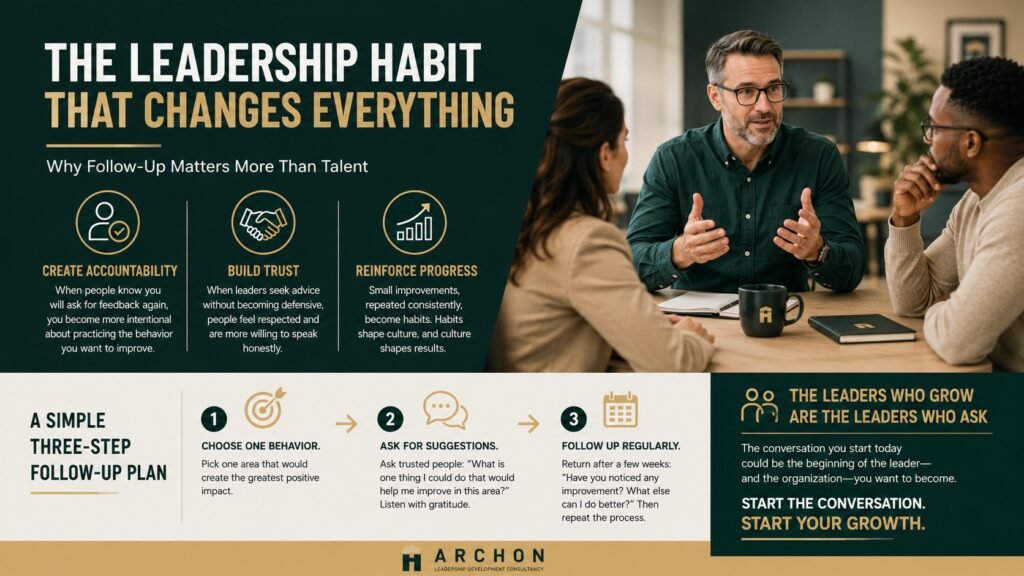
The Leadership Habit Most People Ignore
Why Most Leaders Don’t Improve—Even When They Want To
Many leaders genuinely want to become better.
They attend seminars.
They read books.
They listen to podcasts.
They invest in coaching.
Yet months later, very little has changed.
The problem is not a lack of knowledge.
Most leaders already know what they need to do.
They know they should listen better.
They know they should communicate more clearly.
They know they should delegate more effectively.
They know they should spend more time developing their people.
The challenge is not learning.
The challenge is changing.
According to executive coach Marshall Goldsmith, one simple habit separates leaders who improve from leaders who stay the same:
Follow-up.
A Story About a Business Owner
Carlos owned a growing manufacturing business and, like many entrepreneurs, carried the burden of every major decision. During a leadership workshop, his team shared an unexpected piece of feedback: while they respected his vision and commitment, they felt he didn’t really listen. Carlos was surprised, but after reflecting, he realized he often interrupted people, rushed to solve problems, and rarely asked follow-up questions.
Determined to change, Carlos adopted a simple practice inspired by Marshall Goldsmith. Every month, he asked his team, “What suggestions do you have that can help me become a better listener?” Then he simply listened—without defending, explaining, or arguing. He repeated the process month after month.
Over time, the impact was remarkable. Team members became more willing to speak up, meetings grew more productive, and better ideas surfaced throughout the organization. The transformation did not come from a new training program, but from the power of one simple habit: consistent follow-up.
Why Follow-Up Works
Most leaders make the mistake of treating growth as an event.
They attend a workshop and hope change happens automatically.
But leadership development is not an event.
It is a process.
Goldsmith’s research involving more than 11,000 leaders found that those who regularly followed up with colleagues about their improvement goals were perceived as significantly more effective than leaders who did little or no follow-up.
The lesson is simple:
People believe you are changing when they can see your commitment to change.
Follow-up demonstrates commitment.
It tells people:
“I care enough to keep working on this.”
The Hidden Cost of Not Following Up
When leaders ask for feedback but never revisit the conversation, people eventually stop sharing.
Employees become disengaged.
Ideas remain unspoken.
Trust slowly erodes.
The leader believes they are improving.
The team sees little evidence.
Over time, the gap between perception and reality grows wider.
For business owners, this can become expensive.
Poor communication leads to misunderstandings.
Misunderstandings lead to mistakes.
Mistakes lead to lost opportunities.
A Better Way: The Follow-Up Plan
Marshall Goldsmith recommends a practical approach.
Step 1: Pick One Behavior
Choose the one leadership behavior that will make the biggest positive difference.
Not five.
Not ten.
Just one.
Step 2: Ask for Suggestions
Talk to the people who experience your leadership.
Ask:
“What can I do to improve in this area?”
Step 3: Listen
Avoid defending yourself.
Listen to learn.
Step 4: Thank People
Every suggestion is a gift.
Express appreciation.
Step 5: Follow Up
This is where the magic happens.
Return regularly and ask:
“How am I doing?”
“What else can I do better?”
“What suggestions do you have for me moving forward?”
Leadership Is a Contact Sport
Goldsmith often describes leadership as a “contact sport.”
Leaders do not improve in isolation.
They improve through ongoing interaction with the people they serve.
The leaders who grow the fastest are not necessarily the smartest.
They are the most coachable.
They remain curious.
They ask.
They listen.
They follow up.
The Bottom Line
If you want to become a better leader, don’t focus on learning more.
Focus on changing one behavior that matters.
Then involve the people around you in the process.
Ask for ideas.
Act on those ideas.
And most importantly, follow up.
Because leadership growth does not happen when you attend a seminar.
It happens when people see you consistently working to become better.
And that may be the most powerful leadership lesson of all.
Reflection Question
What is one behavior that, if improved, would make the biggest positive difference in your leadership?
More importantly, who will you ask for help—and when will you follow up?