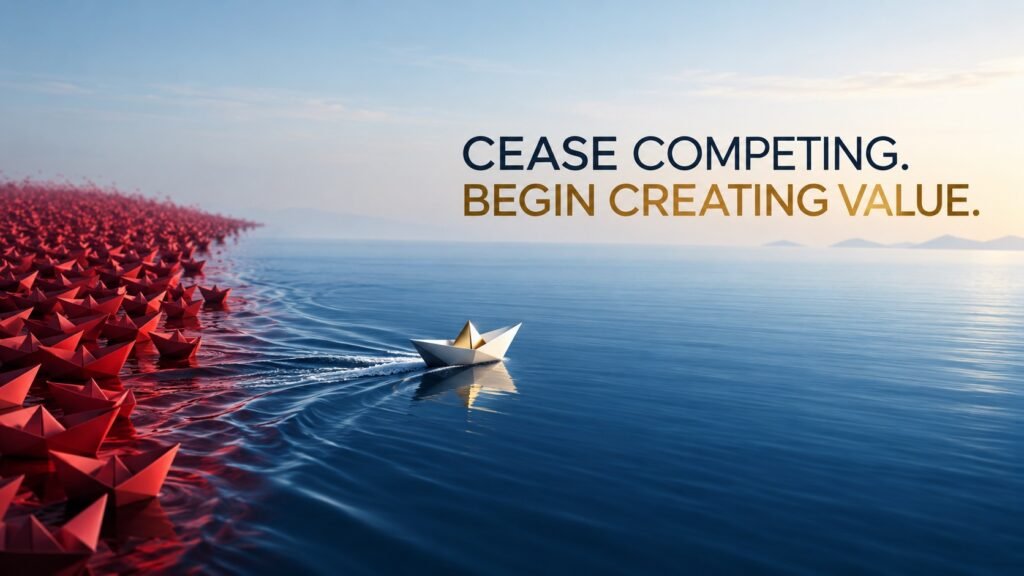
Cease Competing and Begin Creating Value
What Blue Ocean Strategy Can Teach Small Business Owners
If you own a small business, allow me to ask you an important question:
Why should customers choose your business instead of your competitors?
Is it because your price is lower? Is your product better? Or is your service faster?
These are all good reasons. But what happens when your competitors begin offering the same things?
You lower your prices, and they do the same. They launch a promotion, so you launch one too. They add a new service, so you quickly try to match it.
Before you realize it, everyone is competing for the same customers in almost the same way.
I have seen this happen among many small-business owners. They work harder, compete more aggressively, and sometimes sacrifice their profit margins just to keep sales coming in.
Perhaps we need to ask a different question:
Instead of focusing on how to beat our competitors, what if we focused on creating greater value for our customers?
This brings me to a business concept called Blue Ocean Strategy, introduced by W. Chan Kim and Renée Mauborgne.
I believe it contains valuable lessons for small and medium-sized business owners.
Is Your Business Swimming in a Red Ocean?
The authors describe two kinds of markets: Red Oceans and Blue Oceans.
A Red Ocean is a market where businesses compete within the existing rules of an industry.
Think about restaurants competing on price, real estate agents fighting for the same listings, or contractors trying to win projects by submitting the lowest quotation.
Competition is not always bad. It can encourage businesses to improve.
However, when everyone offers something similar, customers tend to choose based on price. And when price becomes the main deciding factor, profitability suffers.
A Blue Ocean, on the other hand, represents new market space where businesses create different value, attract new demand, and make direct competition less relevant.
Instead of asking, “How can we outperform our competitors?” we begin asking:
What do customers truly need that the market is not providing adequately?
That question leads us to a different way of thinking.
You Don’t Always Have to Be Better—You Need to Be Meaningfully Different
Innovation does not always mean inventing something completely new.
Often, it means finding a better or different way of solving an existing problem.
Consider an accounting firm that offers bookkeeping, tax preparation, and compliance services.
What if it went beyond preparing reports and helped SME owners understand those reports, improve cash flow, and make better business decisions?
Instead of being seen only as an accounting service provider, it becomes a financial decision-making partner.
Of course, the opportunity must still be validated because other firms may already be providing something similar.
But the principle remains:
Customers do not simply buy products or services. They buy solutions to problems they want solved.
The goal is not to be different merely for the sake of being different. The goal is to become meaningfully different in a way that customers understand, appreciate, and are willing to pay for.
Four Questions Every Business Owner Should Ask
One practical tool from Blue Ocean Strategy is the Four Actions Framework.
It invites us to examine our businesses by asking four important questions.
1. What Should We Eliminate?
Why do we continue doing certain things simply because everyone else in the industry does them?
Some procedures, features, or services may no longer provide meaningful value to customers. They may only add cost, delay, or complexity.
Eliminating unnecessary activities allows us to focus our resources on what truly matters.
2. What Should We Reduce?
Which activities consume time, money, and energy without providing enough customer value?
SMEs have limited resources. We cannot afford to spend heavily on activities that do not contribute to the customer experience or the profitability of the business.
I frequently remind business owners:
Complexity is the enemy of execution. Simplicity is the secret to scale.
Reducing unnecessary complexity makes the business easier to operate and the customer experience easier to understand.
3. What Should We Raise?
What areas must we improve because customers genuinely value them?
It may be reliability, communication, convenience, speed, customization, or after-sales support.
Sometimes, we do not need to introduce a completely new product. We may simply need to raise the quality of the areas customers care about most.
4. What Should We Create?
What new value can we introduce that customers are not currently receiving?
It could be a new service, a different delivery model, a bundled solution, a membership program, or a strategic partnership.
These four actions help businesses reduce unnecessary expenses while increasing the value they provide to customers.
Blue Ocean Strategy calls this value innovation.
The Trinity of Growth™: Turning Blue Ocean Opportunities Into Business Results
I see a strong connection between Blue Ocean Strategy and the framework I developed in my book, Trinity of Growth™.
Blue Ocean Strategy challenges us to identify new opportunities. But there is an important difference between discovering an opportunity and successfully building a business around it.
A good strategy shows us the direction we want to take. But we still need strong leadership, the necessary capabilities, and the right relationships to reach our destination.
This is where the three pillars of the Trinity of Growth™ become essential.
Pillar 1: Leadership—Seeing What Others Don’t See
Every business transformation begins with leadership.
Creating new market opportunities requires business owners who are willing to question existing assumptions, listen carefully to customers, and think beyond the current practices of their industry.
It requires clear purpose, the courage to make decisions, and the consistency to follow through.
A leader who is always reacting to competitors will struggle to create something original. When all our attention is focused on what others are doing, we may fail to notice what our customers are actually asking for.
If we want to build a different kind of business, we must first learn to think differently as leaders.
Leadership gives us the clarity and courage to move away from familiar practices when those practices are no longer producing value.
Pillar 2: Business Competency—Turning Ideas Into Sustainable Results
A good idea does not automatically become a profitable business.
We must understand our customers, clearly communicate our value, develop the right products, establish an effective sales process, build reliable operating systems, and manage our cash flow.
These business competencies turn opportunities into measurable results.
For example, introducing a new service may attract customers. But without proper pricing, efficient delivery, clear responsibilities, and sound financial management, that opportunity can quickly become another business problem.
As I often say:
Vision without structure is just a dream that keeps you busy.
The systems supporting a Blue Ocean opportunity must be capable of delivering the promised value consistently and profitably.
Creativity may open the door, but competency enables the business to walk through it.
Pillar 3: Network Connections—Discovering Opportunities Beyond Our Business
One thing I have learned through many years of business networking is that opportunities often emerge through relationships.
When we connect with people from different industries, we discover customer problems, gain new perspectives, and uncover possibilities we may never have seen on our own.
A contractor working with an architect may develop a more complete solution for property owners. A travel agency partnering with healthcare providers may discover a new way to serve senior travelers or medical tourists.
Networking, therefore, must go beyond exchanging referrals.
The right connections help us identify opportunities, develop better solutions, and reach markets we could not serve by ourselves.
This is how the three pillars work together:
Leadership helps us recognize opportunities.
Business Competency allows us to transform those opportunities into profitable systems.
Network Connections expand our reach and enable us to create greater value.
Coaching helps business owners bring these three pillars together through clarity, action, and accountability.
My Final Thoughts: Growth Must Be Intentional
Many entrepreneurs work extremely hard yet continue to struggle to make meaningful progress.
The answer is not always to work harder.
Sometimes, we must reconsider how we create value.
Blue Ocean Strategy teaches us to go beyond simply competing. The Trinity of Growth™ reminds us that sustainable growth requires more than a promising idea.
We need the right leadership, the necessary business capabilities, and the relationships that can help us see and pursue new opportunities.
The first step is to listen to your customers. Understand the problems they continue to experience. Identify one opportunity, develop a simple solution, and test it before investing heavily.
Remember:
Companies drift by default. They grow by design.
So here is my challenge to you this week:
What could you do differently to create greater value for your customers if you stopped worrying about what your competitors were doing?
And equally important:
Do you have the leadership, business competency, and network connections necessary to turn that opportunity into sustainable growth?
Discovering an opportunity is only the beginning.
Building a business that consistently delivers that value is where real growth happens.
Perhaps your next breakthrough will not come from lowering your price, adding another promotion, or working longer hours. Perhaps it will begin with one honest conversation with a customer who says, “This is the problem no one has solved for me.”
Listen carefully when that moment comes.
That customer may be pointing you toward your own Blue Ocean.
Do not immediately ask, “How can I sell more of what I already offer?”
Instead, ask:
“What new value can I create that will make my business the natural choice?”
You do not have to win every battle in a crowded market.
You can choose to create a different market, solve a deeper problem, and give customers a compelling reason to move toward you.
That is how competition becomes less relevant.
That is how opportunity becomes growth. And that is how you cease competing—and begin creating value.