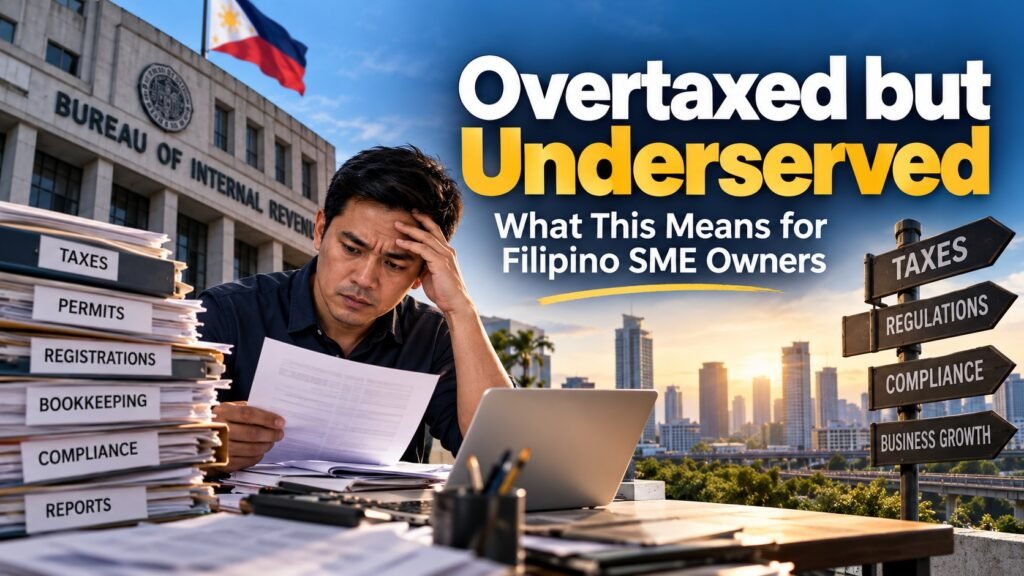
Overtaxed but Underserved: What This Means for Filipino SME Owners
Recently, I came across a statement that made me stop and think:
“The Philippines is overtaxed, yet underserved.”
The statement has been associated with tax reform advocate Mon Abrea. Whether you completely agree with it or not, it raises an important question:
Are we making it unnecessarily difficult for small businesses to do business in the Philippines?
I am not a tax expert. I am a business owner and business coach.
Over the years, I have worked with many entrepreneurs and SME owners. One thing I have learned is that running a small business is already difficult enough.
You have to find customers.
Generate sales.
Manage people.
Watch your cash flow.
Deliver what you promised.
Then, on top of all these responsibilities, you must deal with taxes, permits, registrations, bookkeeping, government requirements and compliance.
Sometimes, the biggest burden is not simply the amount of tax a business must pay.
It is the complexity of doing everything correctly.
The Hidden Cost of Compliance
When we talk about taxes, we normally think about the money paid to the government.
But for an SME owner, there is another cost that is often overlooked:
The cost of compliance.
How many hours do you and your employees spend preparing documents?
How much do you pay for bookkeeping, accounting and professional services?
How much time do you spend trying to understand new requirements?
How many forms, emails, visits and follow-ups are needed just to keep your business compliant?
A large corporation may have an accounting department, finance team, lawyers and compliance officers to handle these responsibilities.
But imagine a business with only five or ten employees.
The owner may already be the salesperson, operations manager, HR manager, collector, customer-service representative and strategist. Then, the same owner is expected to understand tax regulations and every related requirement.
That complexity has a real cost.
Every hour an entrepreneur spends unnecessarily navigating bureaucracy is an hour that could have been spent serving customers, improving operations or growing the business.
Why Simplification Matters
This is why discussions about simplifying taxation and compliance for SMEs are important.
We have already seen reforms such as the Ease of Paying Taxes Act, or Republic Act No. 11976, which introduced changes intended to make tax compliance simpler and more taxpayer-friendly. Policymakers have also proposed further reforms for micro, small and medium enterprises.
The principle behind these efforts deserves serious attention:
Make compliance easier, and you give more businesses the opportunity to become formal, compliant and productive.
Simplification does not mean removing the responsibility to pay taxes. It means making responsible compliance easier to understand and accomplish.
We must also recognize that government needs revenue. Our country needs roads, infrastructure, education, healthcare, security and reliable public services. Businesses benefit when these systems work well.
So, the conversation should not simply be:
“How can businesses pay less tax?”
Perhaps the better question is:
“How can we create a system in which businesses can comply more easily, grow faster and contribute more as they become successful?”
Business Owners Also Have a Responsibility
It is easy to point to the government and say, “They need to fix the system.”
Perhaps they do.
But as entrepreneurs, we must also ask:
“What do I need to fix inside my own business?”
This is where SME owners must take responsibility.
Start with proper bookkeeping.
Know your numbers.
Separate your personal money from your business money.
Understand your cash flow.
Keep your documents organized.
Issue the required invoices.
Know your tax obligations.
Work with competent accountants and advisers.
And please, do not wait until the deadline before looking for your documents.
Many tax problems are not created on filing day. They begin months earlier because the business failed to establish the right systems.
Compliance becomes unnecessarily stressful when everything depends on the owner’s memory, a pile of receipts or a last-minute search for missing documents.
This Is Where Business Competence Matters
In my Trinity of Growth™, I teach that every business owner needs to develop three essential areas:
Leadership. Business Competence. Network Connections.
Tax compliance touches all three.
Leadership means taking responsibility.
Responsible business owners do not hide from their numbers. They understand that proper compliance is part of building a legitimate and sustainable business.
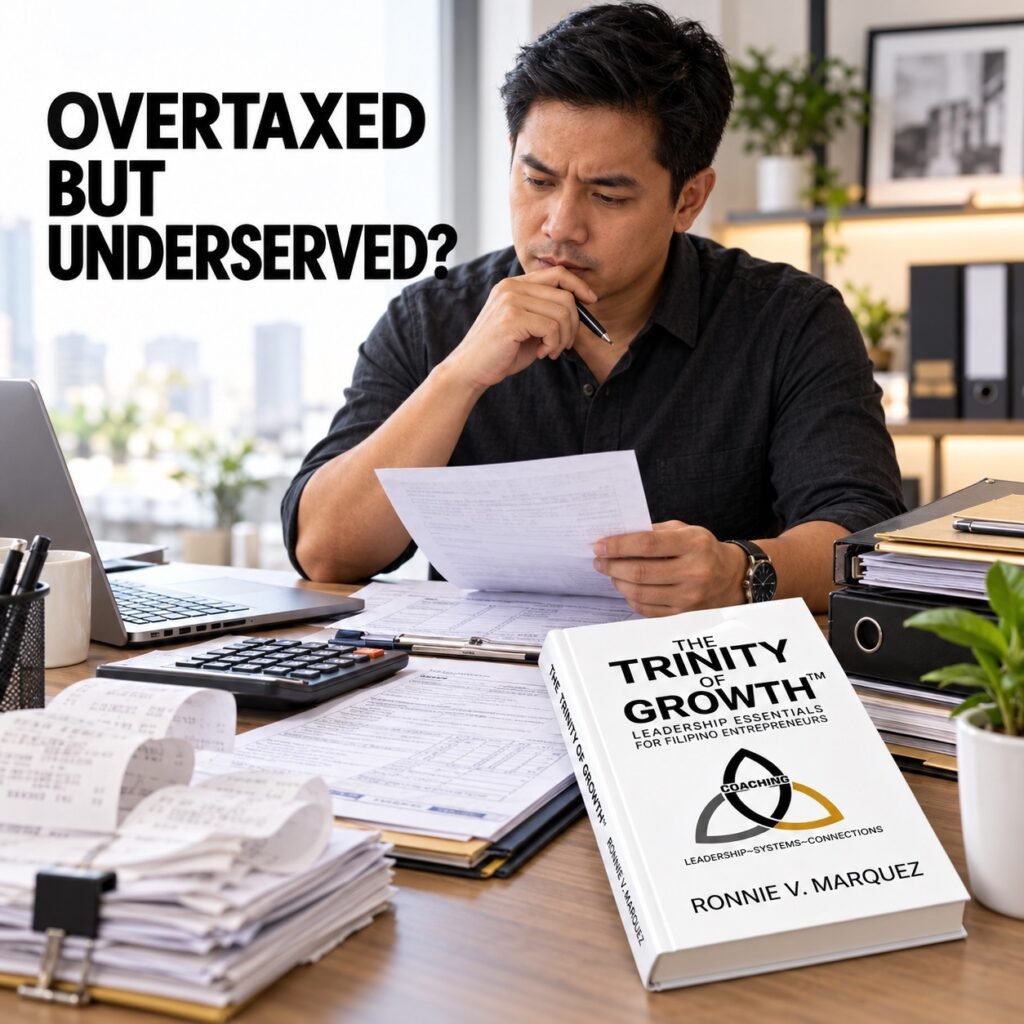 Business Competence means building systems.
Your bookkeeping, accounting, cash-flow management, documentation and financial controls should not depend entirely on your memory. Put clear processes in place. Assign responsibility. Establish a schedule. Review your numbers regularly.
Network Connections means knowing you do not have to understand everything yourself.
Build relationships with competent accountants, tax professionals, lawyers, bankers, business advisers and fellow entrepreneurs.
You do not need to become a tax expert. But you need trusted experts who can guide you.
Sometimes, one conversation with the right professional can protect you from a very expensive mistake.
SMEs Should Have a Voice
Business owners should also participate in the conversation about reform—not simply by complaining, but by offering constructive feedback.
What processes are unnecessarily complicated?
Which requirements are duplicated?
What rules are difficult for microbusinesses to understand?
Which government services could be digitized?
What requirements consume significant time without creating meaningful value?
Business associations, chambers and entrepreneur organizations can bring these concerns together. When business owners speak collectively and constructively, policymakers and regulators can better understand what is happening on the ground.
Good policies need more than good intentions. They must also work in the real world where entrepreneurs are trying to survive, grow and create jobs.
Grow the Business, Not the Complexity
The goal should not be to create businesses that are good at avoiding taxes.
We need businesses that are good at creating value.
Businesses that create jobs.
Businesses that serve customers well.
Businesses that develop people.
Businesses that earn sustainable profits.
And yes, businesses that responsibly pay their taxes.
But we also need an environment that gives these businesses a fair opportunity to succeed.
When good businesses grow, everyone benefits.
Entrepreneurs benefit.
Employees benefit.
Customers benefit.
Communities benefit.
And the government benefits.
So perhaps the conversation should move beyond whether Filipino businesses are “overtaxed yet underserved.”
The more useful question is:
How can we build responsible businesses while creating a system that makes it easier for responsible businesses to succeed?
As SME owners, some things will always be outside our control. But leadership begins with what we can control.
Build your competence.
Strengthen your systems.
Organize your records.
Surround yourself with the right professionals.
Stay compliant.
Keep learning.
And keep growing.
Because companies drift by default. They grow by design.