
Leading Today’s Generation: Leadership Has Changed – Have We?
Over the years, one thing I’ve learned about leadership is this:
What worked for one generation of leaders may not necessarily work for the next.
I’ve had the privilege of leading people from different generations, backgrounds, professions, and stages of their careers. And despite the years I’ve spent leading, I’m still learning how to lead.
Perhaps that is one of the first lessons of leadership:
You never really graduate from it.
People change. The workplace changes. Technology changes. Expectations change.
And if everything around us is changing, leaders must be willing to grow as well.
Sometimes it’s easy for leaders from my generation to look at younger people and say:
“They’re different.”
“They don’t work the way we used to.”
“They ask too many questions.”
“They see work differently.”
And perhaps they do.
But instead of asking, “What’s wrong with this generation?” I believe there is a much better leadership question:
“What does this generation need from me as a leader?”
That question puts the responsibility back on us.
Instead of expecting people to adjust to the way we have always led, perhaps we should also ask:
Do I need to change the way I lead?
From Position to Influence
I grew up professionally in a time when leadership was strongly associated with position.
You became the manager, department head, director, president, or business owner—and people followed because you were in charge.
Organizations still need structure. They still need authority and accountability. But I’ve learned that having authority and having influence are two different things.
Authority can produce compliance. Influence creates commitment.
People may follow your instructions because they have to.
But they give you their ideas, creativity, energy, and commitment because they trust you.
That is why leadership today cannot depend on position alone.
Leadership must increasingly be built on trust, influence, and relationships.
1. From Authority to Trust
Your position tells people what you are responsible for.
Your character tells people whether they can trust you.
People are watching more than we sometimes realize.
They notice whether we keep our promises.
They notice whether we admit our mistakes.
They notice whether we give credit to others.
They notice whether we practice the standards we expect from them.
Trust is rarely built through one big moment.
It is built through many small moments of consistency.
Say what you mean.
Do what you say.
Own your mistakes.
Model what you expect.
Here’s a simple but powerful question to ask your team:
“What is one thing I do that builds your trust in me—and one thing I could do better?”
Then listen.
Don’t explain. Don’t defend.
Sometimes our greatest opportunity to grow as leaders is hidden inside feedback we would rather not hear.
2. From Control to Empowerment
This is especially important for business owners.
When you started your business, you probably did almost everything.
You found customers. You solved problems. You approved expenses. You made decisions. You checked the work.
At the beginning, that may have been necessary.
But as your organization grows, the same behavior that helped you build the business can eventually prevent it from growing.
You become the bottleneck.
Leadership must eventually move from:
“Do what I tell you.”
to:
“Here’s what we need to accomplish. How would you approach it?”
Give people clear expectations. Give them resources. Give them appropriate authority. Then give them room to think, decide, and take ownership.
Empowerment doesn’t mean removing accountability.
It means developing people who can carry responsibility.
Great leaders don’t create people who are dependent on them. They develop people who can eventually lead without them.
3. From Information to Clarity
There was a time when information itself was power.
Today, information is everywhere.
In fact, our challenge is often no longer a lack of information.
It is too much information.
People need leaders who can create clarity in the middle of all the noise.
Where are we going?
Why does it matter?
What is changing?
What is expected of me?
What should we focus on now?
Leaders don’t have to pretend they have every answer.
Sometimes one of the most credible things we can say is:
“I don’t know the answer yet. But here’s what we know, and here’s what we’re going to do next.”
People can handle uncertainty.
What is much harder to handle is confusion.
When the environment becomes complicated, one of the leader’s greatest responsibilities is to create clarity.
4. From Managing People to Developing People
Leadership isn’t only about producing today’s results.
It is also about building tomorrow’s capacity.
This requires us to ask different questions.
Who am I developing?
Who is becoming more capable because I am leading them?
Who am I preparing for greater responsibility?
Who could eventually do what I am doing today?
That last question can be uncomfortable.
But if everything stops when the leader leaves the room, perhaps we haven’t developed enough leaders.
Training is important, but training alone doesn’t develop people.
Development requires:
Responsibility. Coaching. Feedback. Practice. Trust.
Give people opportunities to stretch.
Allow them to make decisions.
Coach them when they make mistakes.
Then give them another opportunity.
That’s how leaders grow.
5. From Managing Generations to Understanding People
We hear a lot about Baby Boomers, Gen X, Millennials, and Gen Z.
Understanding generational differences can certainly help us lead. Different generations grew up in different environments and may have different attitudes toward work, technology, communication, and authority.
But we need to be careful not to put people into boxes.
A generation is not a personality.
Instead of simply asking:
“How do I lead Gen Z?”
Try asking:
“How do I lead this person?”
What motivates them?
How do they prefer to communicate?
What are their strengths?
How do they respond under pressure?
What kind of support do they need?
What responsibility are they ready for?
Effective leaders learn to adjust how they communicate and connect with different people without compromising their values or standards.
Leadership becomes more effective when we stop treating everyone the same and start understanding the person in front of us.
What Hasn’t Changed?
With all these changes in leadership, there is something equally important to remember:
The fundamentals of leadership haven’t changed.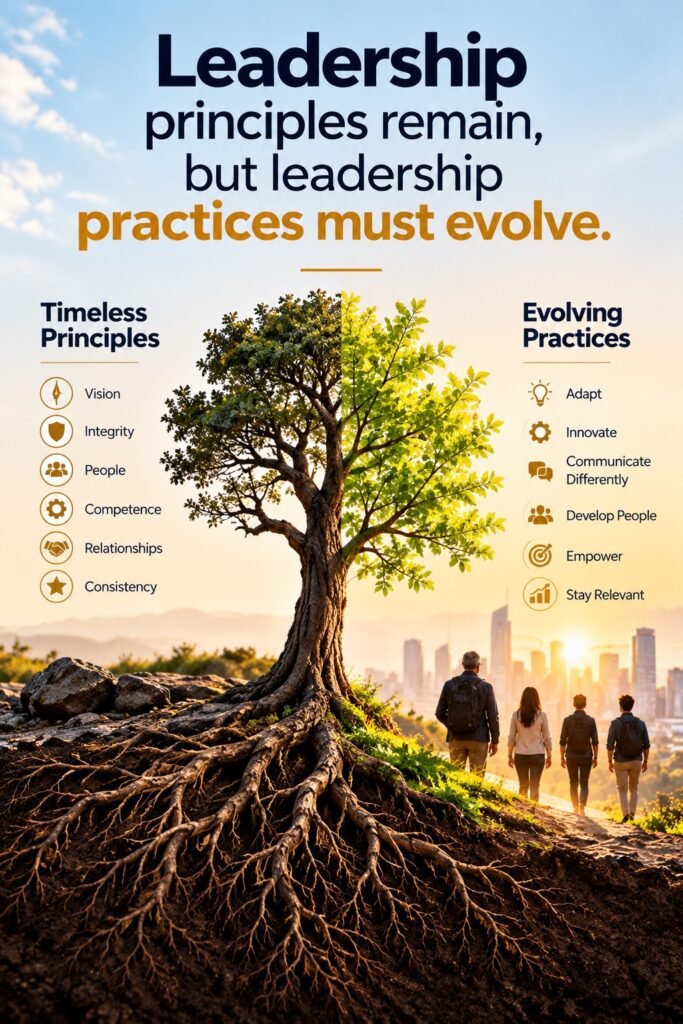
People still need vision.
They still need clarity.
They still need encouragement.
They still need accountability.
They still need leaders they can trust.
Technology has changed.
The workplace has changed.
Generations have changed.
But:
Character still matters.
Integrity still matters.
Competence still matters.
Relationships still matter.
Consistency still matters.
Perhaps leadership itself hasn’t changed as much as the way we practice leadership needs to evolve.
The Leadership Question Has Changed
For me, it starts with leading ourselves first.
Before asking why other people need to change, perhaps we should ask:
How do I need to change?
Do I really listen?
Do I empower people—or control them?
Do I develop leaders—or create people who depend on me?
Am I willing to receive feedback?
Does my behavior reflect the culture I say I want?
Leadership isn’t about becoming the person with all the answers.
It’s about creating an environment where people can think, contribute, take responsibility, grow, and work toward something meaningful.
Maybe the old leadership question was:
“How do I get people to follow me?”
Today, I believe there is a better question:
“How do I help people become better because I had the privilege of leading them?”
Every leadership position eventually ends.
Every title is temporary.
And when our time of leadership is over, the real measure may not simply be what people accomplished while we were there.
It may be what they are capable of accomplishing after we’re gone.
That is why one of the greatest accomplishments of leadership is not simply creating more followers.
It is developing more leaders.